
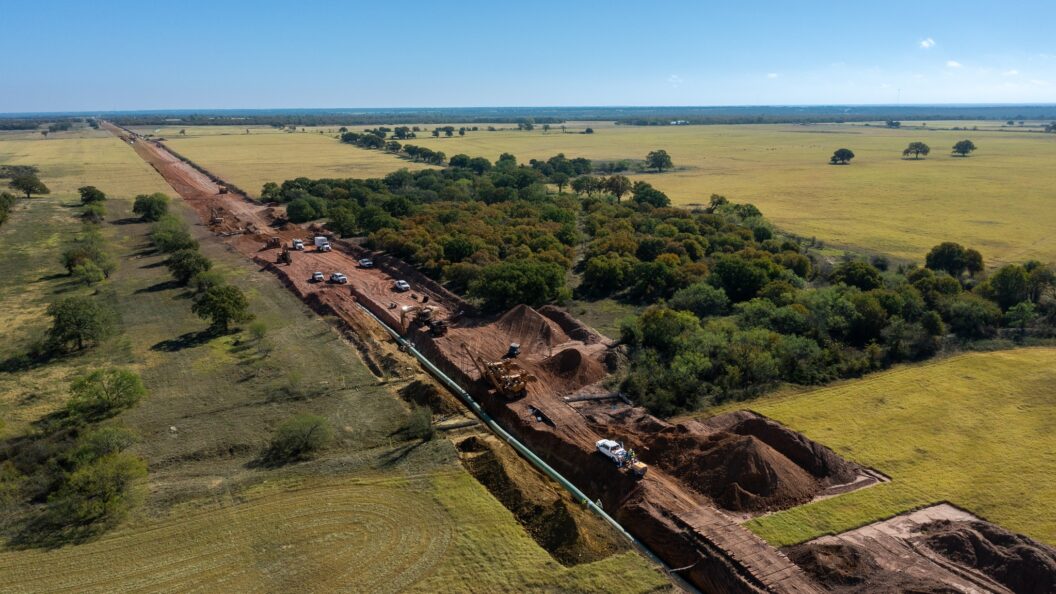
As demand for affordable, reliable energy continues to grow in the United States and around the world, Energy Transfer is advancing major infrastructure projects designed to enhance natural gas transportation, processing, storage and delivery capabilities.
Together, these projects are helping strengthen the infrastructure needed to meet growing demand for natural gas while supporting electric reliability, economic growth and energy security.
Several of these projects are expected to enter service in 2026, marking important milestones in Energy Transfer’s efforts to expand and strengthen its infrastructure network.
Hugh Brinson Pipeline Progressing Toward Service
Construction of the Hugh Brinson Pipeline continues to advance on schedule, with Phase 1 expected to enter service in the fourth quarter of 2026 upon full buildout of the 400-mile pipeline and associated compression required to move 1.5 Bcf/d of gas to customers’ contractual delivery points.
The approximately 400-mile pipeline, along with associated compression facilities, will be capable of transporting 1.5 billion cubic feet (Bcf) of natural gas per day to customers across the system upon completion of Phase 1. If construction stays on the current schedule, Energy Transfer may have the ability to begin flowing gas early in the third quarter, which is prior to placing Phase I into service.
Phase 2 of the project, which includes additional compression, remains on track for service in the first quarter of 2027 and increases the capacity of the pipe to ~2.2 Bcf/d.
The Hugh Brinson Pipeline is fully contracted from west to east, reflecting strong demand for additional natural gas transportation capacity. Additionally, growing commitments for backhaul volumes are expected to provide further growth opportunities for the system.
Once completed, the pipeline will serve as a critical connection point across Energy Transfer’s extensive network of large-diameter natural gas pipelines, enhancing system connectivity and positioning Energy Transfer to serve future customer demand.
Permian Processing Expansion Continues
Energy Transfer is also expanding its natural gas processing footprint in the Permian Basin through the addition of two new processing facilities.
The 275 million cubic feet per day (MMcf/d) Mustang Draw I processing plant went into service in June, and volumes are expected to increase rapidly.
Meanwhile, the 275 MMcf/d Mustang Draw II plant remains on schedule to enter service during the fourth quarter of 2026.
These two facilities will add 550 MMcf/d of processing capacity, helping Energy Transfer meet continued production growth across one of the nation’s most prolific energy-producing regions.
Supporting Growing Power Generation Demand
As electricity demand continues to increase – driven in part by economic growth, industrial development and expanding data center activity – Energy Transfer is investing in infrastructure to deliver reliable natural gas supplies to power generation facilities. Earlier this year, Energy Transfer added connections to serve four new power plant loads in Oklahoma, creating approximately 300 MMcf/d of new natural gas supply capability.
The first connection is already in service, while two additional connections are expected to enter service during the third quarter of 2026. The final connection is scheduled to be completed in the fourth quarter of 2028.
Advancing Future Infrastructure Projects
While several projects are expected to enter service in 2026, Energy Transfer is also advancing longer-term investments that will support future energy demand across key markets.
Desert Southwest Pipeline
Energy Transfer is making progress on its Desert Southwest Pipeline, an approximately 520-mile underground natural gas pipeline project that will expand the long-running Transwestern Pipeline system to increase the supply of much-needed natural gas to Arizona and New Mexico. The natural gas originating in the Permian Basin will help meet rapidly growing electricity demand driven by population increases and economic development throughout the Southwest.
Construction is expected to begin in the second quarter of 2028, with the pipeline anticipated to be placed into service in the fourth quarter of 2029.
Bethel Storage Expansion
Energy Transfer also continues to make progress on a new storage cavern at its Bethel natural gas storage facility. Upon completion in late 2028, the project is expected to more than double the facility’s working gas storage capacity to more than 12 Bcf, providing additional flexibility to serve customers and meet peak demand.
Springerville Lateral
Energy Transfer recently approved the construction of the new Springerville Lateral, an approximately 125-mile, 30-inch pipeline connecting the Transwestern Pipeline system to two regional generating stations in Apache County, Arizona. The project will allow these two power generation facilities to use natural gas rather than coal to generate much-needed electricity. This project is backed by 20-year agreements and is expected to be in service in the fourth quarter of 2029.
Meeting America’s Growing Energy Needs
These projects represent important investments in the infrastructure needed to meet growing demand for natural gas across multiple sectors of the economy. From expanding pipeline connectivity and processing capacity to supporting power generation and increasing storage capabilities, Energy Transfer continues to focus on safely delivering projects that strengthen energy reliability and support long-term economic growth.
