
This year marks the 30th anniversary of National Safety Month, an annual observance held each June by the National Safety Council that focuses on preventing injuries and deaths in workplaces, on roadways and in communities.
While National Safety Month provides an opportunity to highlight the people, programs and investments that help ensure safety remains a top priority for every employee, every day, safety is a year-round commitment at Energy Transfer.
That commitment continues to produce results. Last year, we achieved the best performance in our company’s history, with a record-breaking OSHA Total Recordable Injury Rate (TRIR). This marked our third consecutive year of TRIR improvement, reflecting our unwavering commitment to a zero-incident workplace. We also lowered our Preventable Vehicle Incident Rate (PVIR) by 20% in 2025.
These metrics continue a decade-long trend of excellence, during which we have reduced our TRIR by nearly 62% and our PVIR by 46%.
This sustained performance is made possible by the people, programs and investments that support Energy Transfer’s culture of safety and operational excellence.
Investing in Operational Integrity
At Energy Transfer, maintaining the highest safety standards is essential to delivering excellence across our operations. We prioritize operational integrity through a culture of safety and compliance, supported by the $1.06 billion we invested in maintenance initiatives in 2025 to help ensure the continued safety and reliability of our assets.
Operational excellence also entails utilizing cutting-edge technologies, such as artificial intelligence (AI) and machine learning (ML), to derive data-driven insights that optimize asset performance and maintenance. In 2025, Energy Transfer launched a new initiative to implement ML in our rotating equipment to help predict potential failures, detect abnormal operations, and identify performance deviations across our portfolio. We also utilize AI and ML for damage prevention, pipeline optimization and pipeline integrity.
Ongoing training is another vital component of Energy Transfer’s safety culture. To achieve regulatory compliance, field employees undergo regular training both in the classroom and on the job. This is supplemented with a robust internal and external auditing program that ensures policies are implemented effectively.
Together, advanced technology, rigorous training and a highly skilled workforce help Energy Transfer maintain safe, reliable and responsible energy infrastructure.
Promoting Safe Driving

One example of how Energy Transfer continuously strengthens its safety culture is DriverCare Connect, a data-driven initiative for our 7,200 drivers operating company vehicles, developed by our Operations Support Safety Team. This innovative text-based program offers real-time weekly safety reminders delivered straight to employees’ mobile phones.
The messages cover topics such as distracted driving, maintaining a safe following distance, and staying rested to prevent drowsiness. Each week’s message draws from real data, observed behaviors, and lessons learned. This direct line of communication has become a vital tool in our mission to ensure every driver returns home safely at the end of their shift.
Volunteer Emergency Response
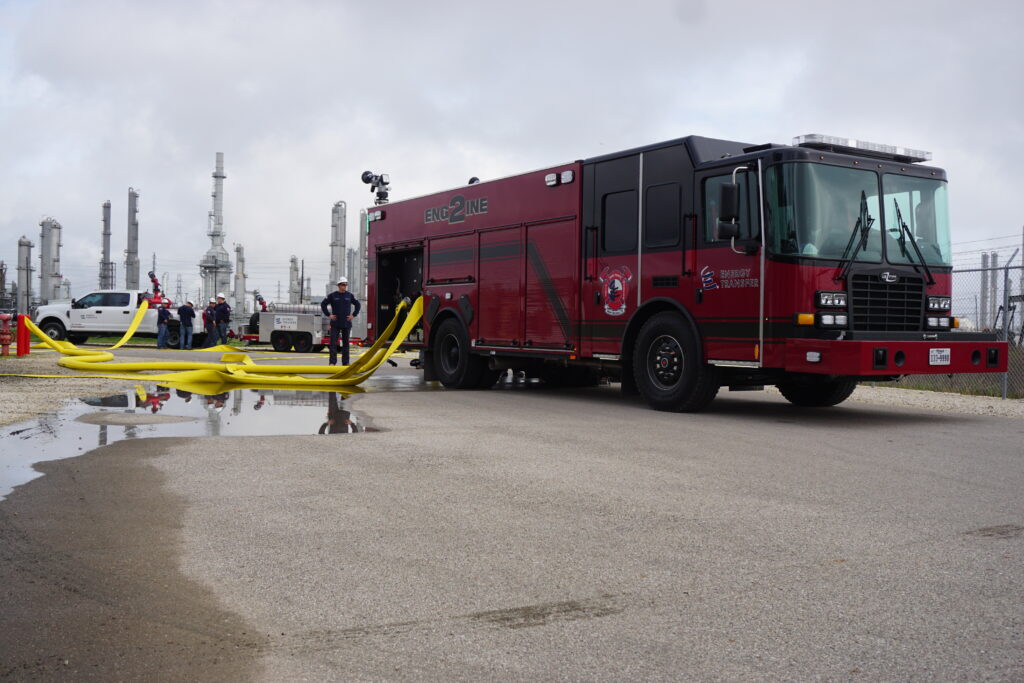
For many Energy Transfer employees, safety extends beyond their day-to-day responsibilities. Our volunteer emergency response teams play a critical role in supporting safe and reliable operations across Energy Transfer’s facilities. Comprised entirely of employee volunteers at our Mont Belvieu Facility, Nederland Terminal, Houston Fuel Oil Terminal and Marcus Hook Terminal, these highly trained teams are prepared to respond quickly and effectively to a wide range of industrial emergencies. Because team members work at these facilities every day and possess deep familiarity with facility operations, equipment and layouts, they can provide immediate response capabilities to help minimize incident escalation and support the protection of employees, communities and critical infrastructure.
Employee volunteers undergo extensive specialized training and regularly train together at Energy Transfer sites to strengthen coordination and preparedness. Teams also work closely with local city and county fire departments, emergency responders and mutual aid organizations in their respective areas.
During National Safety Month and throughout the year, Energy Transfer remains committed to protecting our employees, communities and assets through a culture of safety, continuous improvement and operational excellence. By combining advanced technology, rigorous training and employee engagement, we continue working toward our ultimate goal of a zero-incident workplace.
